
Field Service Operations: How to Stay Competitive

Remember when phones hung on walls with cords that stretched all the way to the kitchen? Back then, “mobility” meant how far your cord would stretch before snapping.
Fast forward to today, and our phones are essentially pocket-sized supercomputers that manage everything from maps to meals. Field Service Operations is on the same trajectory—if you’re still relying on yesterday’s systems, you’re basically stuck with the cord.
Welcome to the final blog in this three-part series, inspired by the book 42 Rules for Superior Field Service.
In Part 1, I covered why agility matters when the unexpected hits, and Part 2 showed how intuitive design keeps teams from wrestling with their tools.
Now, in Part 3, I’m bringing it all together with Rule 42: Evolve Constantly. Because standing still in field service is about as inefficient as trying to stream Netflix on dial-up... it never ends well.
Why Is It Important to Evolve Constantly in Field Service Operations?
Evolution isn’t a luxury, but more like a make-or-break strategy. With customer expectations climbing, competitors racing ahead, and legacy systems acting like anchors instead of engines, Field Service Operations that don’t adapt risk turning into fossils. Sticking with outdated tools is like showing up to a job site with a flip phone—you can technically make it work, but you’ll miss out on everything that makes life easier.
Evolving constantly means leaning into mobile workforce management, real-time data, and operational efficiency as the new baseline. These aren’t extras anymore; they’re table stakes.
How Is AI Transforming Field Service Management?
AI isn’t a flashy add-on—it’s more like a dependable crew member who never sleeps.
It powers automated scheduling, dispatch optimization, and even chatbots that handle routine customer questions. The result? Less time wasted on manual planning and more time focused on customers.
Take scheduling as an example: predictive algorithms can reduce downtime and boost response times by automatically assigning the right technician with the right skills to the right job, no spreadsheets required.
And because it’s part of the Business Central + Microsoft ecosystem, these AI capabilities don’t sit in isolation. They connect seamlessly with your ERP, CRM, and collaboration tools, so data flows across your entire operation.
Today’s platforms even embed AI and IoT capabilities that help companies anticipate issues and respond faster, keeping your team a step ahead rather than always playing catch-up.
What Is Predictive Maintenance and How Does It Work in Field Service?
Predictive maintenance flips the old repair model on its head. Instead of waiting for something to fail, IoT sensors and analytics predict problems in advance, like a weather app that tells you to grab an umbrella before you head out for a walk.
According to industry research summarized by OxMaint, predictive maintenance programs can deliver a 10× return on investment, reduce downtime by up to 50%, and cut maintenance costs by 10–40% across a range of industries. That’s not just efficiency; that’s your bottom line breathing a sigh of relief.
How Can IoT Improve Equipment Tracking and Service Response Times?
With IoT-connected devices, your assets stop being silent and start sending updates in real time. Need to know where that generator is or how it’s performing? No problem. And if usage patterns look off, the system can trigger a service request automatically.
It’s like having equipment that raises its hand and says, “I need attention,” before a customer calls in frustrated. That’s how Field Service Operations shift from reactive to proactive, and from firefighting to foresight. And as we discussed back in Part 1 of this series, planning for the unexpected becomes much easier when connected assets are already feeding you real-time data.
What Technologies Help Future-Proof Field Service Operations?
Future-proofing isn’t about chasing every shiny new tool—it’s about building a toolkit that grows with you. Some of the essentials include:
Cloud ERP and mobile apps for anytime, anywhere access
AI and predictive analytics to anticipate issues before they escalate
IoT devices to provide constant, connected insights
AR tools for hands-on, remote guidance
User-centered design that ensures tools actually get used
Beyond just tools, scaling Field Service Operations requires consistency. As companies grow their technician teams, guided workflows and enforced task flows ensure critical steps aren’t skipped. That means every customer visit feels consistent, no matter which technician shows up; a major win for both service quality and leadership peace of mind.
These aren’t short-lived fixes; they’re the backbone of future-proof field service strategies. The right combination ensures your systems not only work now, but also adapt as your business evolves.
And because these tools are built on Microsoft’s cloud ecosystem, you gain the flexibility to pivot as needs change, the integration to connect every part of your business, and the benefit of Microsoft’s continuous innovation... so your technology keeps improving long after it’s deployed.
How Do I Prepare My Service Business for Digital Transformation?
Digital transformation isn’t a light switch, but more like a dimmer you adjust over time. The key is to start small with a practical roadmap:
Audit your current setup to identify pain points
Pinpoint gaps in agility, insight, and automation
Choose scalable platforms like Business Central + WennSoft
Pilot small - prove value, then expand
Prioritize adoption with clean interfaces, clear workflows, and training
Another area where evolution pays off? Billing. Better data collection and automated review steps cut down on the post-visit paperwork that slows cash flow.
Faster, more accurate invoicing means less time chasing revenue and more time serving customers. Think of it like renovating a house—you wouldn’t tear out every wall at once (I hope!).
And as my previous blog in this series showed, intuitive design is the secret sauce for adoption. If tools feel natural to use, your teams won’t just accept change; they’ll run with it.
Continuous Evolution as a Competitive Edge
Let’s recap this series:
Part 1 showed why agility matters when the unexpected hits.
Part 2 proved simplicity keeps adoption high.
Now, Part 3 brings it home with Rule 42: Evolve Constantly... because innovation never pauses.
In field service, standing still isn’t actually standing still. It’s more like sliding backward while the competition races past. The companies that thrive aren’t the ones with the flashiest tech; they’re the ones that keep upgrading their toolkit.
Ready to trade anchors for engines? Reach out to learn how WennSoft can help you move your Field Service Operations into the future with Business Central.
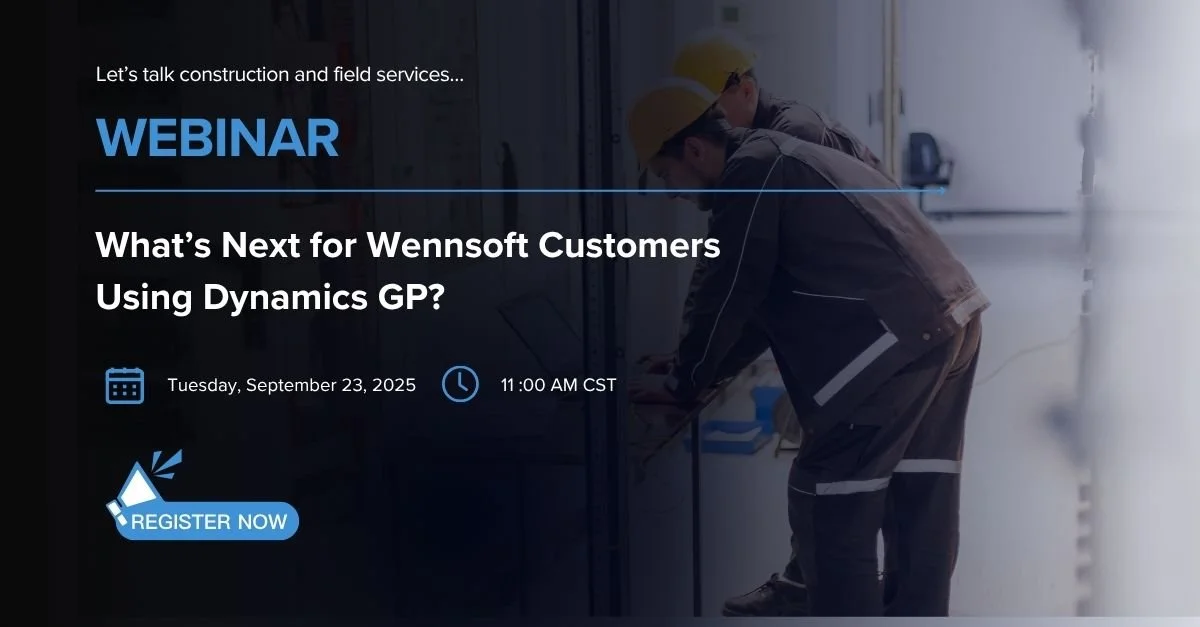
Or join our upcoming Webinar, where we’ll focus on what you can expect if and when you evolve to Business Central.
About the Author

Richard Haus is a technology leader with over 30 years in construction software innovation. As CEO of WennSoft, he helps contractors modernize operations with purpose-built Microsoft technologies that improve efficiency and drive long-term success. He has led the development of industry-transforming solutions like Signature Time, Signature Telematics, and our new Cloud Field Service, all designed to optimize workflows and enhance productivity for the skilled trades.
Passionate about problem-solving and continuous improvement, Richard believes success – whether in business or the outdoors – comes from preparation, the right tools, and a willingness to adapt.
Connect with Richard on LinkedIn to continue the conversation.